

Artificial intelligence is transforming the workplace faster than most organizations can adapt. From legal firms and healthcare providers to software companies and financial institutions, employees are using ChatGPT, Claude, Gemini, Copilot, and dozens of other AI tools to improve productivity and reduce repetitive work.
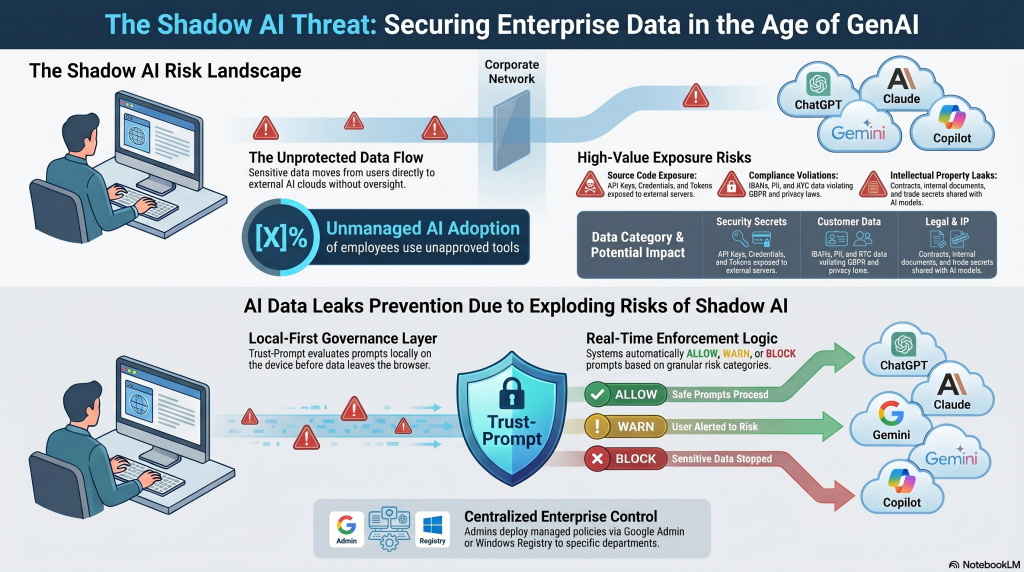
However, a new cybersecurity challenge is rapidly emerging. The growing role of Shadow AI is creating significant governance, compliance, and data protection risks that many organizations are only beginning to understand.
Recent AI News stories, data breach investigations, and security reports reveal a common pattern: employees are sharing sensitive information with AI systems without realizing the potential consequences. As AI adoption accelerates, organizations face a new reality where traditional security controls are often unable to detect or prevent AI-related data exposure.
The result is a growing demand for AI data leaks prevention due to exploding risks of shadow ai.
What Is Shadow AI?
Shadow AI refers to the use of artificial intelligence tools without formal approval, oversight, or governance from an organization’s IT, security, or compliance teams.
Much like “Shadow IT” emerged years ago when employees adopted unauthorized software, Shadow AI occurs when workers use AI applications independently to solve business problems.
Examples include:
- Uploading confidential contracts into ChatGPT
- Using AI to summarize sensitive meeting notes
- Sharing customer data with AI assistants
- Using personal AI accounts for work-related tasks
- Connecting AI agents to corporate systems without approval
In many cases, employees are not acting maliciously. They are simply trying to work more efficiently. Unfortunately, even well-intentioned actions can expose valuable intellectual property, regulated data, and confidential business information.
Why AI Data Leaks Are Becoming a Major Security Concern
The latest cybersecurity News highlights a growing trend: AI systems are becoming one of the most common pathways for accidental data exposure.
Unlike traditional file transfers, AI interactions often happen through conversational prompts. Employees may paste:
- Customer information
- Financial records
- Legal documents
- Source code
- Internal reports
- Employee records
directly into AI tools.
Many organizations have extensive controls around email, cloud storage, and file sharing. However, they often lack visibility into what employees are typing into AI applications.
This creates a blind spot that attackers, regulators, and compliance teams are increasingly paying attention to.
Lessons from the Samsung ChatGPT Incident
One of the most widely discussed examples involved Samsung engineers who reportedly uploaded proprietary semiconductor information into ChatGPT while seeking assistance with debugging and documentation tasks.
The incident became a landmark example of how easily confidential business data can leave an organization through AI tools.
Although the employees were attempting to improve productivity, the event demonstrated that even trusted staff members can unintentionally expose sensitive information.
The Samsung case remains one of the strongest examples of why organizations need AI governance and AI data leaks prevention due to exploding risks of shadow ai.
The Fiverr Data Leak and the Broader Security Conversation
Another topic receiving attention across the cybersecurity industry is the Fiverr Data Leak discussion.
While not every reported data exposure is directly caused by AI, incidents involving online platforms, third-party services, and cloud applications highlight an important lesson: organizations increasingly depend on external systems that process sensitive information.
The Fiverr Data Leak conversation reinforces a growing concern among security professionals. Once information leaves an organization’s controlled environment, visibility and governance become significantly more difficult.
As AI tools become integrated into daily workflows, organizations must carefully evaluate how data moves between users, applications, cloud services, and AI platforms.
Why Traditional Security Tools Often Miss AI Risks
Most existing security controls were designed before generative AI became mainstream.
Traditional tools typically focus on:
- Email monitoring
- File transfers
- Endpoint security
- Network traffic
- Cloud storage activity
AI interactions introduce a completely different data flow.
A user can copy and paste sensitive information into an AI chatbot within seconds. If no AI-specific controls exist, the interaction may go completely unnoticed.
This is why many security experts believe prompt-level protection will become a critical layer of modern cybersecurity programs.
The Rise of AI Governance in 2026
AI governance has quickly moved from a niche discussion to a boardroom priority.
Organizations are now asking important questions:
- Which AI tools are employees using?
- What data is being shared with AI systems?
- Are employees following company policies?
- Can we prevent sensitive information from reaching public AI models?
- How can we comply with evolving AI regulations?
The growing role of Shadow AI is forcing organizations to rethink governance strategies.
Instead of banning AI entirely, many companies are implementing policies, training programs, monitoring systems, and AI governance solutions that enable safe AI adoption.
AI Data Leaks Prevention
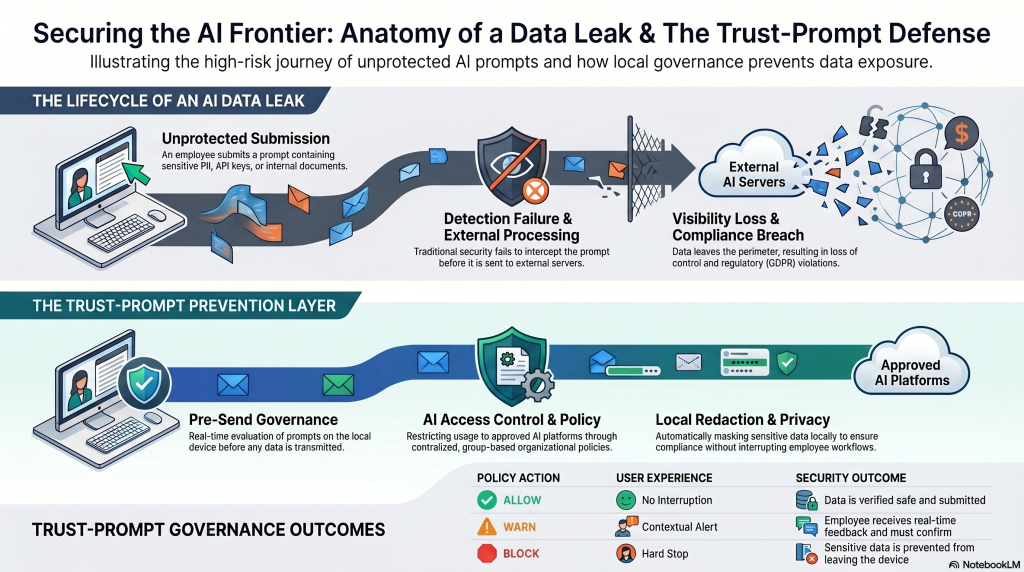
The most effective approach to AI security is prevention. Once sensitive information has been submitted to an AI system, organizations may lose visibility and control over how that information is processed, stored, or shared.
This is why AI data leaks prevention due to exploding risks of shadow ai is becoming one of the most important priorities for security teams.
Effective prevention strategies include:
- Employee awareness training
- AI usage policies
- Prompt monitoring
- Data classification
- Real-time warning systems
- Automated redaction
- Browser-level AI governance controls
Organizations that implement preventative controls can significantly reduce the likelihood of accidental disclosures while still benefiting from AI-driven productivity gains.
How Trust Prompt Helps Organizations Reduce AI Risk
Trust Prompt was created to help organizations address the growing challenge of Shadow AI.
By focusing on the moment before information is submitted to AI systems, Trust Prompt provides organizations with an additional layer of protection.
Key benefits include:
- Prompt-level data inspection
- Sensitive information detection
- Real-time user warnings
- Policy enforcement
- AI governance support
- Reduced risk of accidental disclosures
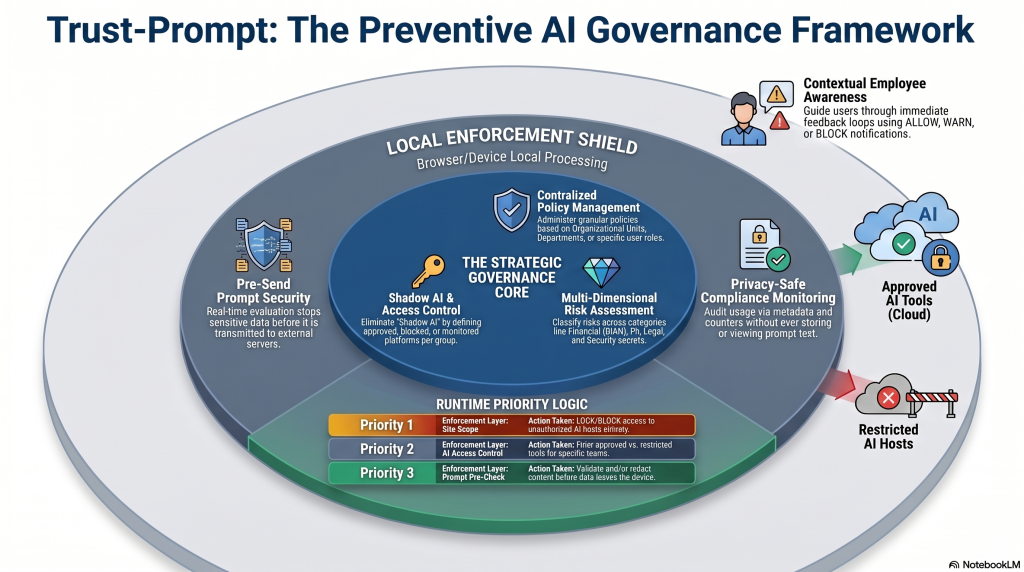
Rather than restricting innovation, Trust Prompt enables organizations to adopt AI responsibly while maintaining control over sensitive information.
The Future of AI Security
AI adoption will continue to accelerate throughout 2026 and beyond.
At the same time, cybercriminals, regulators, compliance teams, and enterprise security leaders are paying closer attention to how AI systems are used inside organizations.
The companies that succeed will be those that embrace innovation while implementing practical safeguards.
The latest News stories consistently point toward the same conclusion:
Organizations need visibility, governance, and prevention strategies to address the growing role of Shadow AI before AI-related data exposure becomes a business crisis.
Frequently Asked Questions
What is Shadow AI?
Shadow AI refers to employees using artificial intelligence tools without formal approval, governance, or oversight from their organization’s IT or security teams.
Why are AI data leaks increasing?
AI data leaks are increasing because employees frequently share sensitive information with AI systems to improve productivity, often without realizing the associated risks.
Can traditional DLP solutions prevent AI data leaks?
Traditional DLP solutions can help but may not detect prompt-based interactions with AI systems. Additional AI-specific governance controls are often required.
What industries are most vulnerable to Shadow AI?
Financial services, legal firms, healthcare organizations, government agencies, and software companies are particularly vulnerable due to the sensitivity of their data.
How does Trust Prompt help prevent AI data leaks?
Trust Prompt helps organizations identify sensitive information before it is submitted to AI tools, reducing the risk of accidental disclosures and supporting AI governance efforts.