

Let’s be honest: the speed at which AI has hit our desks is dizzying. One day we’re experimenting with ChatGPT for fun, and the next, it’s a core part of our workflow. But this “AI gold rush” has landed businesses in a tricky spot. We are currently caught between the strict privacy rules of the GDPR and the massive new framework known as the EU AI Act. While the productivity gains are real, so are the AI data breach risks. If personal data or trade secrets slip into a public model, you can’t just “undo” it. Staying compliant isn’t about boring paperwork anymore; it’s about setting up a “Precheck Layer” that catches mistakes before they leave your computer.
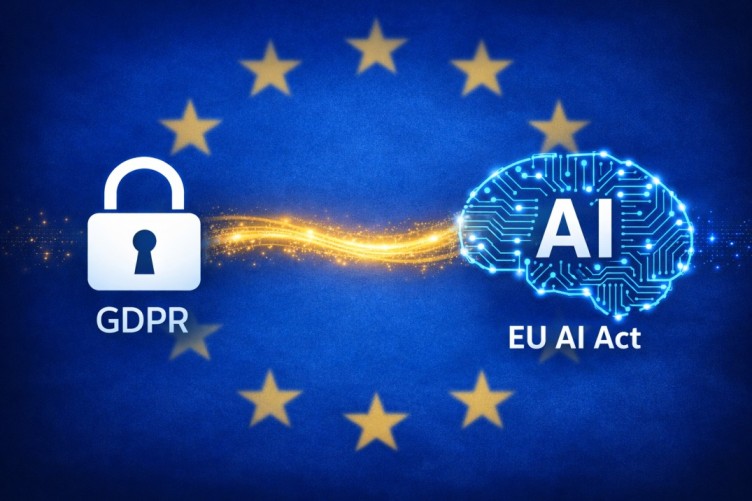
The Intersection: How the EU AI Act Complements GDPR
There’s a common myth that the EU AI Act replaces the GDPR. In reality, they work together like a lock and a key. Think of the GDPR as the protector of your personal data and your rights. The EU AI Act, on the other hand, is a product safety law—it regulates the technology itself based on how “risky” it is.
| Feature | GDPR | EU AI Act |
| Main Goal | Protecting your right to privacy. | Ensuring AI is safe and ethical. |
| How it Judges Risk | Based on the impact on individuals. | A four-tier system (from “Minimal” to “Banned”). |
| Who it Targets | Data Controllers and Processors. | AI Providers and the companies using them. |
| The Cost of Failure | Up to €20M or 4% of global revenue. | Up to €35M or 7% of global revenue. |
Identifying High-Risk AI Systems Under the New Framework
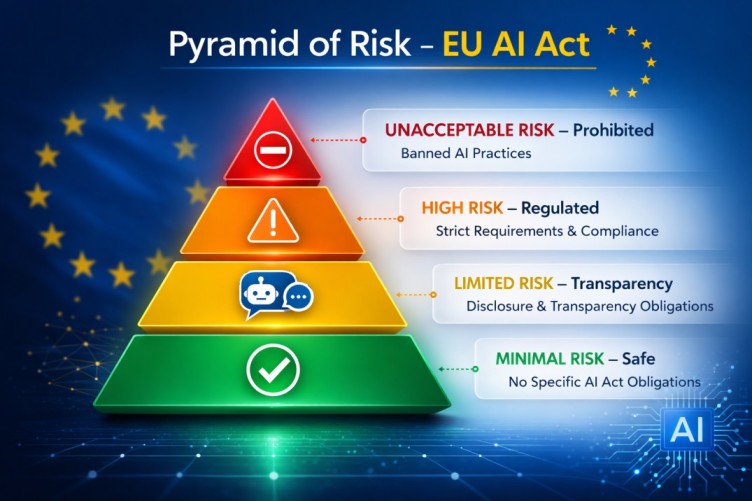
The EU AI Act doesn’t treat all AI the same. It breaks them down into four categories, and knowing where your tools sit is the first step to staying out of legal trouble.
- Unacceptable Risk: This includes things like social scoring or AI that uses manipulative “subliminal” tricks. These are flat-out banned.
- High-Risk: If you’re using AI in healthcare, law enforcement, or for hiring people, you’re in the “High-Risk” zone. This requires massive oversight and strict data rules.
- Limited/Minimal Risk: This is where most everyday chatbots and generative tools live. The main rule here is transparency—people need to know they’re talking to a machine, not a human.
Bridging the Compliance Gap with Real-time Intervention
Understanding the law is great, but how do you actually stop a busy employee from pasting a customer’s bank details into a prompt? You need a technical “safety net”. This is where a “Precheck Layer” comes in. It runs locally on the user’s device and scans the text the moment they hit “Send”. If it sees something sensitive, it flags it immediately. By automating this barrier, you can let your team enjoy the perks of AI without worrying about a massive regulatory headache.
The Danger of “Shadow AI” and Sensitive Data Leaks
We’ve all seen it: an employee wants to save time, so they feed a proprietary script or a sensitive email into a public AI to “clean it up”. What they don’t realize is that their input might be used to train the next version of that AI. This is how Chat-gpt data leak stories start. In fields like Finance or iGaming, Safeguarding sensitive data is a non-negotiable legal requirement under both GDPR and the new AI Act.
Strategy 1: Implementing a “Local-First” Data Privacy Layer
To keep your data safe, you need to catch it before it hits the cloud. Many companies are now using browser-based tools to act as a digital filter.
- Intercepting the “Send” Action: These tools watch the “Send” button in real-time.
- Smart Detection: They use pattern matching to find IBANs, credit card numbers, or API keys instantly.
- Visual Warnings: Banners like “Checking,” “Warning,” or “Blocked” keep the user in the loop without slowing them down.
Strategy 2: Data Minimization and Purpose Limitation
One of the golden rules of GDPR is to only use the data you actually need (Article 5). When it comes to AI, this means:
- Cleaning your data: Always strip out names and emails (anonymization) before using a generative model.
- Sticking to the plan: Don’t let your AI tools start “drifting” into processing data they weren’t meant for.
- Turning off training: If you’re on a business plan, make sure the “training on my data” setting is toggled off.
Strategy 3: Enhancing Human Oversight and Accountability
The EU AI Act is very clear: you cannot just “set it and forget it” when it comes to high-risk systems.
- Trust but verify: AI can hallucinate or be biased. A human should always be the final judge on important tasks.
- Keep a paper trail: Maintain logs of how you’re using AI. If a regulator ever knocks on your door, you’ll need an audit trail to show you did your due diligence.
- Be transparent: If an AI is helping you make decisions that affect customers, tell them. It’s a requirement for both GDPR and the AI Act.
Leveraging Tools for Automated Compliance

Let’s be real—you can’t watch every employee’s screen 24/7. You need automation to do the heavy lifting. Trust-Prompt Features help by using a local ruleset to flag sensitive “Special category data” (like health or political info) that is strictly protected under GDPR. This “Zero-Trust” approach means you can use the world’s best AI models while keeping your most valuable data on your own network.
Future-Proofing for 2026 and Beyond
The clock is ticking. Most of the EU AI Act’s transparency rules will be in full effect by August 2026. Here is what you should be doing right now:
- Do your homework: Run Data Protection Impact Assessments (DPIAs) for your AI projects.
- Update your policy: Make sure your privacy policy explicitly mentions which AI tools you use and why.
- Train your people: Instead of just sending an email, run a workshop. Show your team how to “clean” a prompt before hitting enter.
Conclusion: Innovation Without Compromise
You don’t have to choose between being an “AI-first” company and a “Privacy-first” company. By focusing on local-first security, you can have both. When you use technical filters to catch mistakes at the source, you empower your team to innovate safely, keeping your data exactly where it belongs—under your control.
Frequently Asked Questions (FAQ)
Does the EU AI Act apply to me if my company is in the US or UK?
Yes, if your AI output is used within the EU. Much like GDPR, the EU AI Act has a “long arm” and applies to anyone providing AI systems to the European market.
Can I still use ChatGPT for work and be GDPR compliant?
Yes, but you need a solid legal reason (like “legitimate interest”) and you must ensure your employees aren’t leaking PII into models that use that data for training.
What’s the difference between a DPIA and a FRIA?
A DPIA is a GDPR requirement focused on privacy risks. A FRIA is a new requirement under the AI Act for high-risk systems to ensure they don’t violate basic human rights, like fairness or non-discrimination.
What happens if a leak actually occurs?
If it’s a personal data breach under GDPR, you have to document it and potentially tell your national regulator within 72 hours.
How does “Local-First” tech actually work?
It’s like a filter on your tap. Instead of checking the water at the treatment plant (the cloud), the tool checks the “water” (your prompt) right at the faucet (your browser). No data is sent to a server for the check, so it’s much safer.