

OpenAI has introduced Lockdown Mode and standardized “Elevated Risk” labels — marking an important shift in how AI security risks are communicated and mitigated.
As AI systems become more connected to the web, third-party applications, and enterprise data sources, new threat vectors are emerging. Among them, prompt injection has become one of the most discussed risks in the AI security landscape.
What Is Prompt Injection?
Prompt injection occurs when malicious or manipulated instructions are embedded inside external content — such as a webpage, document, email, or connected app — in an attempt to override an AI system’s instructions or extract sensitive information.
In advanced scenarios, attackers may attempt to:
- Extract confidential company data
- Access connected enterprise applications
- Trigger unintended actions
- Bypass system safeguards
As AI assistants gain browsing capabilities and integration with external tools, the potential attack surface expands.
What Is OpenAI’s Lockdown Mode?
Lockdown Mode is an advanced, optional security setting designed primarily for enterprise environments and high-risk user roles.
When enabled, it:
- Restricts how ChatGPT interacts with external systems
- Limits browsing to cached content
- Disables certain network-based capabilities
- Applies deterministic constraints to reduce data exfiltration risks
This is a system-level safeguard — focused on limiting exposure after a prompt has already entered the AI environment.
Elevated Risk Labels: Transparent Risk Communication
In addition to Lockdown Mode, OpenAI is standardizing how potentially higher-risk capabilities are labeled across ChatGPT, Codex, and other tools.
Features that introduce network exposure or expanded access now carry an “Elevated Risk” label, helping users understand the potential security implications before enabling them.
This improves transparency and reflects a growing maturity in AI governance.
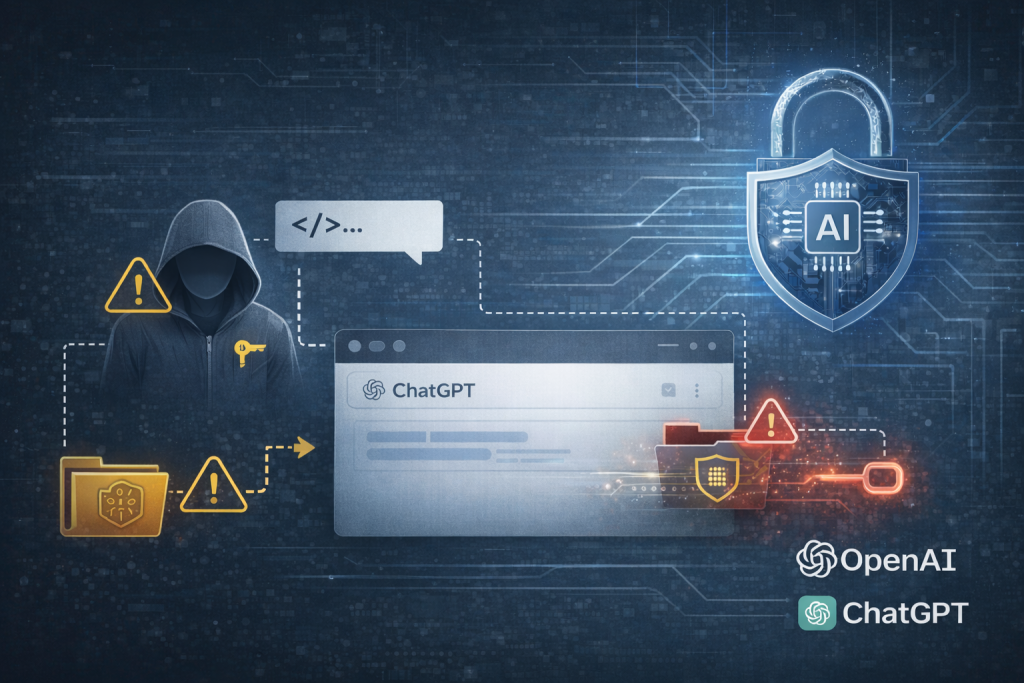
Data Exfiltration: The Expanding AI Risk Surface
While infrastructure-level protections such as Lockdown Mode reduce system exposure, one major risk vector remains: human input.
In everyday workflows, employees may unintentionally submit:
- Personal data (GDPR-relevant information)
- Financial identifiers (IBAN, credit card data)
- Internal company documents
- API keys or authentication tokens
- Health or special category data
Once transmitted to an AI system, this data enters external processing environments. Even with enterprise safeguards in place, preventable exposure can occur before infrastructure protections are applied.
The Missing Layer: Pre-Send Protection
Lockdown Mode protects how AI systems interact with the outside world. But an important question remains:
What protects the user before pressing “Send”?
A pre-send security layer operates locally in the browser, detecting sensitive content patterns before data leaves the device.
This approach helps:
- Identify high-risk personal or financial data
- Warn users before submission
- Block critical content when necessary
- Keep inspection local without transmitting data elsewhere
This is where solutions like Trust-Prompt introduce an additional security layer – operating directly in the browser before prompts are sent to AI platforms.
Instead of replacing provider safeguards, pre-send protection complements them. It adds a preventive layer to AI governance strategies.
Layered AI Security Is Becoming the Standard
The introduction of Lockdown Mode and Elevated Risk labeling confirms a broader trend: AI security is evolving into a layered architecture.
Modern AI governance increasingly includes:
- Model-level safeguards
- Infrastructure isolation
- Workspace administration controls
- Risk transparency labeling
- Pre-submission protection mechanisms
Organizations evaluating AI risk strategies should consider how these layers interact – especially under regulatory frameworks such as GDPR and the EU AI Act.
To understand how a pre-check layer works in practice, see our technical overview:
Final Perspective
OpenAI’s introduction of Lockdown Mode represents an important advancement in AI system security. It signals industry recognition of prompt injection and data exfiltration as real operational risks.
As AI adoption accelerates across enterprises, layered protection models – combining infrastructure controls with user-level safeguards – will define responsible AI deployment.
AI security is no longer theoretical. It is operational.