

Testing & Quality Evidence
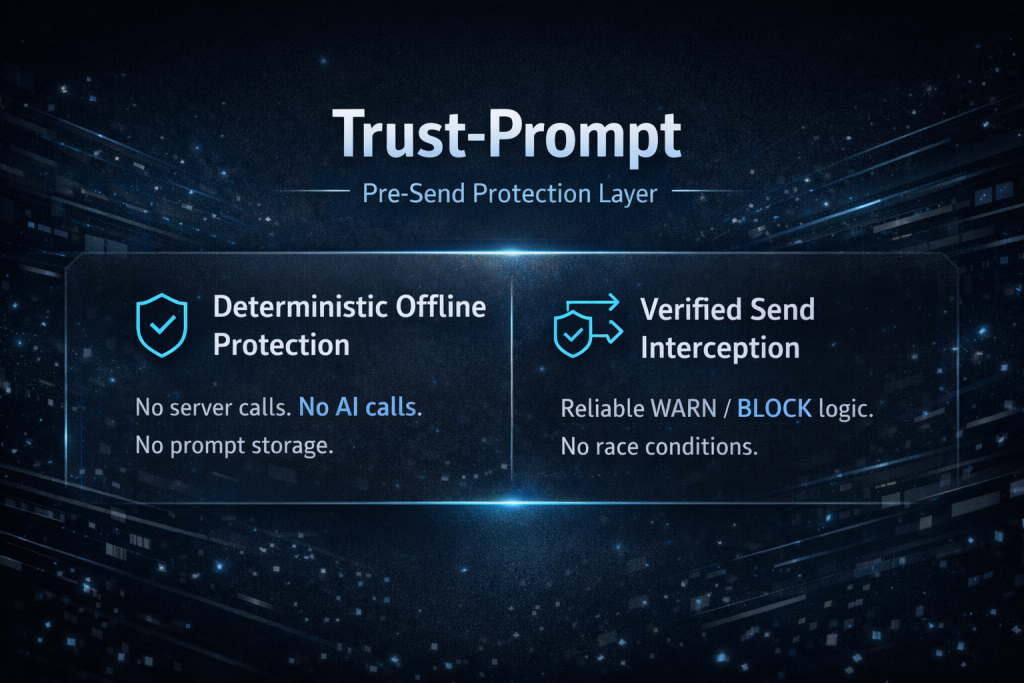
Trust-Prompt is built around deterministic, offline checks — therefore our testing process is equally deterministic, reproducible, and verifiable.
For every release, we execute an automated Gold Matrix Test Suite, high-volume stress tests, and manual UX verification. The goal: ensure warnings and blocks are reliable and cannot be bypassed by rapid clicks, keyboard shortcuts, or timing issues.
What We Test
- Financial Data Protection (BLOCK)
Valid IBAN detection, card number combinations (expiry / CVV). - Secrets & Tokens (BLOCK)
Common API key formats, authentication headers, provider tokens. - Personal Data Indicators (WARN)
Email addresses, phone numbers, and structured postal patterns. - False-Positive Guards (ALLOW)
Known safe strings that must not trigger unnecessary alerts. - UX Reliability
Enter key, Send button, rapid clicks, paste+send, replay protection. - Upload Policy
Upload detection triggers a warning. StoreBasic does not read or analyze files.
How We Test (High-Level)
- Gold Matrix Tests
Curated cases mapped to expected outcomes (ALLOW / WARN / BLOCK). - Load & Stress Tests
Thousands of randomized cases to validate stability and distribution accuracy. - Manual Verification
Real interaction testing inside ChatGPT to confirm no race conditions.
Example Results (Latest Internal Run)
Numbers animate when this section becomes visible.
Responsible Disclosure Policy
To prevent adversarial bypassing, we do not disclose detection patterns, exact test strings, or rule internals. Our objective is to demonstrate a rigorous, repeatable QA process while preserving the integrity and resilience of the protection layer.